In 2023, Canada went through its worst wildfire season on record. More than 15 million hectares burned – over seven times the 40-year average. Communities evacuated, and smoke reached as far as the United States. In 2021, catastrophic flooding in British Columbia displaced thousands and caused billions in damage.
These are not random events. They are clear signs of a climate crisis that has been building for decades. And while the disasters dominate the news, networks of organizers, youth groups, and policy coalitions have been steadily pushing Canada to respond.
Over the past ten years, climate organizing has grown across the country, from youth campaigns calling for The Green New Deal for Canada to national networks shaping federal policy and alliances backing climate champions. We look at who is driving this movement, what they have achieved, and how it connects to the broader push around Canada’s green new deal.
The Rise of Climate Coalitions in Canada
When Canada signed the Paris Agreement in 2015, it pledged to cut greenhouse gas emissions 30% below 2005 levels by 2030. That target has since been strengthened to 40–45%, alongside a commitment to reach net-zero by 2050.
These promises did not appear out of thin air. They followed years of pressure from environmental groups, Indigenous nations, labour unions, faith communities, and thousands of Canadians who showed up at town halls, marches, and ballot boxes.
“Climate change is an existential challenge. It is a threat of the highest order to the country, and indeed to the world.”
– Supreme Court of Canada, 2021 (carbon pricing ruling)
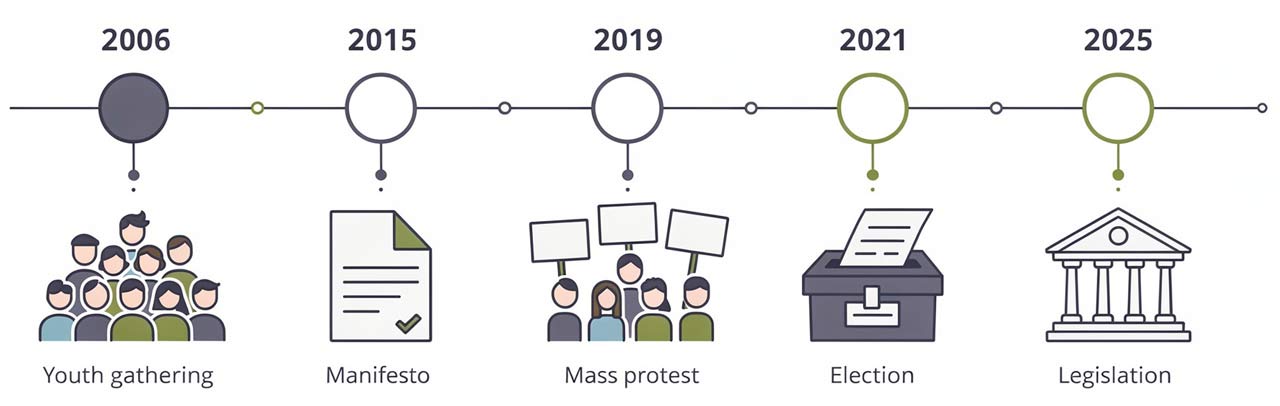
The timeline shows how momentum built. In 2006, the Canadian Youth Climate Coalition formed as the first national youth-led climate network, sending delegates to UN conferences and building grassroots ties. In 2015, the Leap Manifesto introduced a bold plan for economic transformation. By 2019, climate organizing reached a high point: hundreds of thousands joined strikes, and Our Time for a Green New Deal gathered over 500,000 signatures calling for televised climate debates.
The 2021 federal election brought a new strategy – targeted campaigns to elect climate champions. Seven MPs backed by the Climate Emergency Alliance won seats.
So, what is the green new deal in the Canadian context? The idea, inspired by U.S. debates but adapted here, calls for rapid decarbonization, large public investment in clean energy, and a just transition for workers and communities. Support for green new deal proposals has grown, especially among younger voters.
Not every coalition works the same way. Some focus on street-level mobilization. Others draft policy submissions. Some centre elections. Others focus on climate adaptation rather than cutting emissions. Seeing these differences helps us understand the broader movement shaping Canada’s green new deal conversation.
The impact of this growing climate movement now extends far beyond federal targets and policy debates. As decarbonization becomes a national priority, industries across the economy, from energy and manufacturing to finance and digital services, are increasingly expected to measure, disclose, and reduce their environmental footprint, reflecting a broader shift toward transparency, sustainability, and long-term resilience in how business operates.
How Industries Are Responding to Climate Pressure
Different industries are adapting in different ways. Some focus on reducing direct emissions. Others invest in renewable energy procurement, carbon reporting, or ESG disclosure frameworks. Even sectors that function primarily online are part of this conversation, as digital infrastructure, data centres, payment systems, and cloud services, carries its own environmental impact.
This can also be seen in digital entertainment. Platforms built around paid user activity, including the wider online casino market, rely on the same backbone that drives much of the online economy: data-heavy hosting, real-time payment routing, and constant verification flows. These layers of infrastructure, often invisible to users, shape how digital businesses operate and how their impact is assessed. A practical look at how these ecosystems function illustrates the operational mechanics behind real money casino environments and the systems that keep them running.
Understanding these shifts helps frame the broader landscape in which climate coalitions operate and sets the context for examining the key movements shaping Canada’s green transition.
Key Climate Coalitions and Movements
Below are key climate coalitions and movements shaping today’s environmental agenda.
The Pact for a Green New Deal
In May 2019, Greenpeace Canada and over 150 partner organizations launched The Pact for a Green New Deal – the most ambitious attempt yet to build a national coalition around transformative climate policy.
The campaign organized more than 150 town halls across the country, gathering input from over 7,000 participants. The result was a set of demands: cut emissions by 50% by 2030, phase out fossil fuels by 2040, implement the United Nations Declaration on the Rights of Indigenous Peoples, and create one million jobs in the green economy.
Canada’s green new deal vision, as articulated by the Pact, went beyond carbon targets. It called for universal pharmacare, affordable housing, and a just transition for fossil fuel workers. The campaign helped shift the national conversation in the lead-up to the 2019 federal election, making climate a top-tier issue for the first time.
Launched | May 2019 |
|---|---|
Type | National coalition campaign |
Lead Organizer | Greenpeace Canada & 150+ partners |
Focus | Green New Deal, climate justice |
Key Achievement | 150+ town halls, national policy vision |
Status | Campaign concluded |
Our Time for a Green New Deal
If the Pact provided the policy vision, Our Time brought the energy. Launched in 2019 as the youth wing of 350 Canada, Our Time mobilized tens of thousands of young Canadians around a simple demand: a Green New Deal for Canada.
The numbers were remarkable. Over 500,000 people signed a petition calling for federal leaders to participate in climate debates. An estimated one million Canadians joined the September 2019 climate strikes – the largest climate mobilization in the country’s history.
Our Time also pushed for legislative action. NDP MP Peter Julian introduced Motion M-1 in Parliament, calling for a Green New Deal framework. While the motion did not pass, it marked the first time the concept received formal consideration in the House of Commons.
“We are the first generation to feel the effects of climate change and the last generation that can do something about it.”
– Our Time campaign messaging, 2019
Founded | 2019 |
|---|---|
Type | Youth-led campaign |
Affiliated With | 350 Canada |
Focus | Green New Deal advocacy |
Key Achievement | Motion M-1 in Parliament, 500K+ signatures |
Status | Local hubs continue autonomously |
The Leap Manifesto
Before the Pact, before Our Time, there was the Leap. Released in September 2015, the Leap Manifesto called for Canada to transition to 100% renewable energy, respect Indigenous rights and sovereignty, and fundamentally restructure the economy around care, not extraction.
The manifesto was signed by prominent Canadians including author Naomi Klein, environmentalist David Suzuki, and musician Neil Young. It sparked immediate controversy particularly within the NDP, where delegates debated its adoption at the 2016 convention.
The Leap did not become official party policy. But it shifted the terms of debate. Ideas that seemed radical in 2015, a just transition for workers, energy democracy, the integration of Indigenous rights into climate policy, are now part of mainstream discourse.
Launched | September 2015 |
|---|---|
Type | Policy manifesto / movement |
Focus | Economic transformation, climate justice |
Key Achievement | Shifted national climate debate |
Notable Supporters | Naomi Klein, David Suzuki, Neil Young |
Climate Emergency Alliance
By 2021, the movement had learned a lesson: mobilization matters, but so do elections. The Climate Emergency Alliance, backed by 350 Canada, took a targeted approach identifying swing ridings where climate-focused candidates could win.
The strategy was explicitly cross-partisan. The goal was not to support one party, but to elect individuals committed to ambitious climate action regardless of political affiliation. Volunteers knocked on doors, made phone calls, and organized local events in key ridings.
Seven candidates backed by the alliance won their seats, including Blake Desjarlais in Edmonton Griesbach, who defeated a climate-skeptic incumbent. The campaign demonstrated that climate could be a winning electoral issue.
Founded | 2021 |
|---|---|
Type | Electoral campaign |
Affiliated With | 350 Canada |
Focus | Electing climate champions |
Key Achievement | 7 MPs elected |
Approach | Cross-partisan voter mobilization |
Climate Action Network Canada (CAN-Rac)
While grassroots campaigns mobilize public pressure, someone needs to do the policy work. That is where Climate Action Network Canada comes in.
Founded in 1989, CAN-Rac is the country’s largest climate coalition, bringing together over 200 member organizations – from environmental groups to labour unions to faith communities. The network coordinates civil society input on federal climate policy, participates in international negotiations at COP summits, and publishes analysis of Canada’s progress toward its targets.
CAN-Rac operates less visibly than street-level campaigns, but its influence runs deep. The network’s submissions have shaped Canada’s Nationally Determined Contributions under the Paris Agreement and informed the design of federal climate programs.
Founded | 1989 |
|---|---|
Type | Coalition network |
Members | 200+ organizations |
Focus | National policy, international diplomacy |
Key Work | NDC submissions, COP participation |
Climate Proof Canada
Not all climate work is about reducing emissions. Climate Proof Canada focuses on the other half of the equation: adaptation.
Launched in 2021, this coalition brings together an unusual mix of partners – insurance companies, municipalities, Indigenous organizations, disaster relief agencies, and environmental NGOs. Their shared concern: Canada is not prepared for the climate impacts already locked in.
The coalition advocates for a robust National Adaptation Strategy, better flood mapping, resilient infrastructure, and support for communities on the frontlines of climate change. As wildfire seasons grow longer and flood risks increase, this work becomes more urgent.
Founded | 2021 |
|---|---|
Type | Cross-sector coalition |
Focus | Climate adaptation, disaster resilience |
Members | Insurance, municipalities, Indigenous orgs, NGOs |
Key Work | National Adaptation Strategy advocacy |
Canadian Coalition for Environmental and Climate Justice (CCECJ)
Climate change does not affect everyone equally. Low-income communities, Indigenous nations, and racialized Canadians bear disproportionate impacts, from polluted air and water to displacement from extreme weather.
The Canadian Coalition for Environmental and Climate Justice centres these communities in its work. Operating through the MakeWay shared platform, CCECJ has focused particularly on environmental racism – the pattern of locating polluting industries near marginalized communities.
The coalition’s flagship campaign targeted Bill C-226, the National Strategy Respecting Environmental Racism and Environmental Justice Act. In February 2025, the bill received Royal Assent – a landmark victory and the first federal legislation explicitly addressing environmental racism in Canada.
Founded | Early 2020s |
|---|---|
Type | Justice-focused coalition |
Focus | Environmental racism, climate justice |
Key Achievement | Bill C-226 passed (2025) |
Platform | MakeWay shared platform |
Canadian Youth Climate Coalition (CYCC)
Before Our Time, before Fridays for Future, there was the Canadian Youth Climate Coalition. Founded in 2006, CYCC was the first national youth-led climate organization in Canada.
The coalition brought together 48 youth organizations, sent delegations to UN climate conferences, and organized PowerShift conferences that trained a generation of young activists. Many of the leaders who later built Our Time and other campaigns cut their teeth in CYCC.
CYCC is less visible today, but its legacy matters. The organization proved that young people could be serious players in climate politics – a lesson that shaped everything that came after.
Founded | 2006 |
|---|---|
Type | Youth coalition |
Focus | Youth representation, climate advocacy |
Key Activities | COP delegations, PowerShift conferences |
Legacy | Paved the way for Our Time, Fridays for Future |
Canada’s Climate Movement by the Numbers
The scale of climate organizing in Canada is often underestimated. Here is a snapshot of the movement’s reach:
Metric | Figure |
|---|---|
Major climate coalitions active in Canada | 15+ |
Canadians at 2019 Climate Strike | ~1 million |
Town halls held by The Pact (2019) | 150+ |
Petition signatures (Our Time) | 500,000+ |
Climate champions elected (2019-2021) | 15+ MPs |
Organizations in CAN-Rac network | 200+ |
Canadians who believe climate is changing | 83% |
Support for climate action | 58% |
Climate Data and Canada’s Commitments
Understanding the context helps explain why these coalitions exist. Canada faces a significant gap between its climate commitments and its current trajectory.
Official targets: Canada has committed to reducing emissions by 40-45% below 2005 levels by 2030, and by 45-50% by 2035. The country has also pledged to reach net-zero by 2050. Carbon pricing is set to rise to $170 per tonne by 2030.
Current emissions: In 2022, Canada emitted approximately 708 megatonnes of CO2 equivalent. Oil and gas extraction accounts for about 26% of emissions, with transportation at a similar share.
Climate impacts: Annual average temperatures in Canada have risen by 1.7°C since 1948. Northern Canada has warmed by 2.3°C – roughly three times the global average. The 2023 wildfire season burned more than seven times the 40-year average area.
“Canada’s rate of warming is about twice the global rate: a 2°C increase globally means a 3 to 4°C increase for Canada.”
– Environment and Climate Change Canada
International assessment: The Climate Action Tracker rates Canada’s overall climate action as ‘Highly Insufficient’ meaning current policies are not consistent with the Paris Agreement’s 1.5°C temperature limit. To align with 1.5°C, Canada would need to increase its climate ambition by 160-215%, depending on the scenario.
Do These Coalitions Change Anything?
So yeah, Canada has a lot of climate coalitions. But do they make a difference?
The evidence suggests they do – though the pathways are not always direct. When a million people march for climate action, politicians notice. The 2019 federal election saw climate ranked as a top issue for the first time – a shift that campaign organizers helped create.
Policy networks like CAN-Rac influence the details of legislation. Their technical submissions shape carbon pricing systems, clean fuel standards, and emissions caps. Electoral campaigns translate public concern into parliamentary seats – the seven MPs elected with Climate Emergency Alliance backing now vote on climate legislation.
And sometimes, coalitions change what seems politically possible. Ideas from the Leap Manifesto – a just transition, energy democracy, respecting Indigenous rights – moved from the margins to the mainstream over a decade of sustained advocacy.
Challenges and Criticism
The movement faces real obstacles.
The most obvious tension: Canada continues to expand fossil fuel production even as it commits to emissions cuts. The federal government approved the Bay du Nord offshore oil project in 2022 and supported the Trans Mountain pipeline expansion. For critics, this undermines the credibility of climate commitments.
Provincial politics complicate the picture. Alberta and Saskatchewan have pushed back against federal carbon pricing. Economic concerns are real – workers in oil and gas communities worry about their livelihoods. And some argue the movement has prioritized symbolic wins over structural change. Emissions keep rising. The gap between Canada’s targets and its actual trajectory remains wide.
So Where Does That Leave Us?
Canada’s climate movement has grown remarkably over two decades. From a handful of youth activists attending UN conferences in 2006 to million-person marches in 2019. From radical manifestos to legislation addressing environmental racism.
The Pact for a Green New Deal helped define what a transformative climate agenda could look like. Our Time proved young people could mobilize at scale. The Leap Manifesto shifted the terms of debate. Electoral campaigns demonstrated climate could be a winning issue.
And yet emissions remain high. Fossil fuel production continues. International assessors rate Canada’s efforts as insufficient.
The movement has won significant battles. It has not yet won the war. But the coalitions remain, and the pressure persists.
Editorial Note: This article is an independent editorial analysis published under the current management of this website. It is not affiliated with, endorsed by, or connected to any previous owners, operators, or campaign organizers referenced above. All information is presented for informational purposes based on publicly available sources.